
 CN
CNPractical Guide to GEO Optimization for Traditional Factory Acquisition and Transformation
When AI starts screening suppliers for buyers
In March 2025, an old factory in Dongguan that had been manufacturing injection molds for 20 years received an unfamiliar inquiry. The other party is a consumer electronics brand in Shenzhen, with a large purchase volume and high requirements. The boss, Lao Chen, later learned that this customer had entered "Recommended for High-Precision Injection Mold Factory in South China" in DeepSeek and saw the name of their factory before taking the initiative to contact him. Lao Chen's factory had never invested a penny in online advertising before, and sales relied entirely on the boss's connections and industry reputation. The change occurred three months ago, when his daughter helped the factory do one thing, GEO optimization.
GEO, the full name of generative engine optimization, is the infrastructure for enterprises to gain customers in the era of AI answers. Its working principle is not complicated. It uses a series of technical means to allow your enterprise information to appear in the AI knowledge base in a way that conforms to the understanding logic of the large model. When potential customers use AI tools to search for suppliers, AI can accurately recommend your business in the answers. The importance of this matter cannot be overemphasized, as the decision-making portal for B2B procurement is rapidly migrating from search engines and e-commerce platforms to AI dialogs.
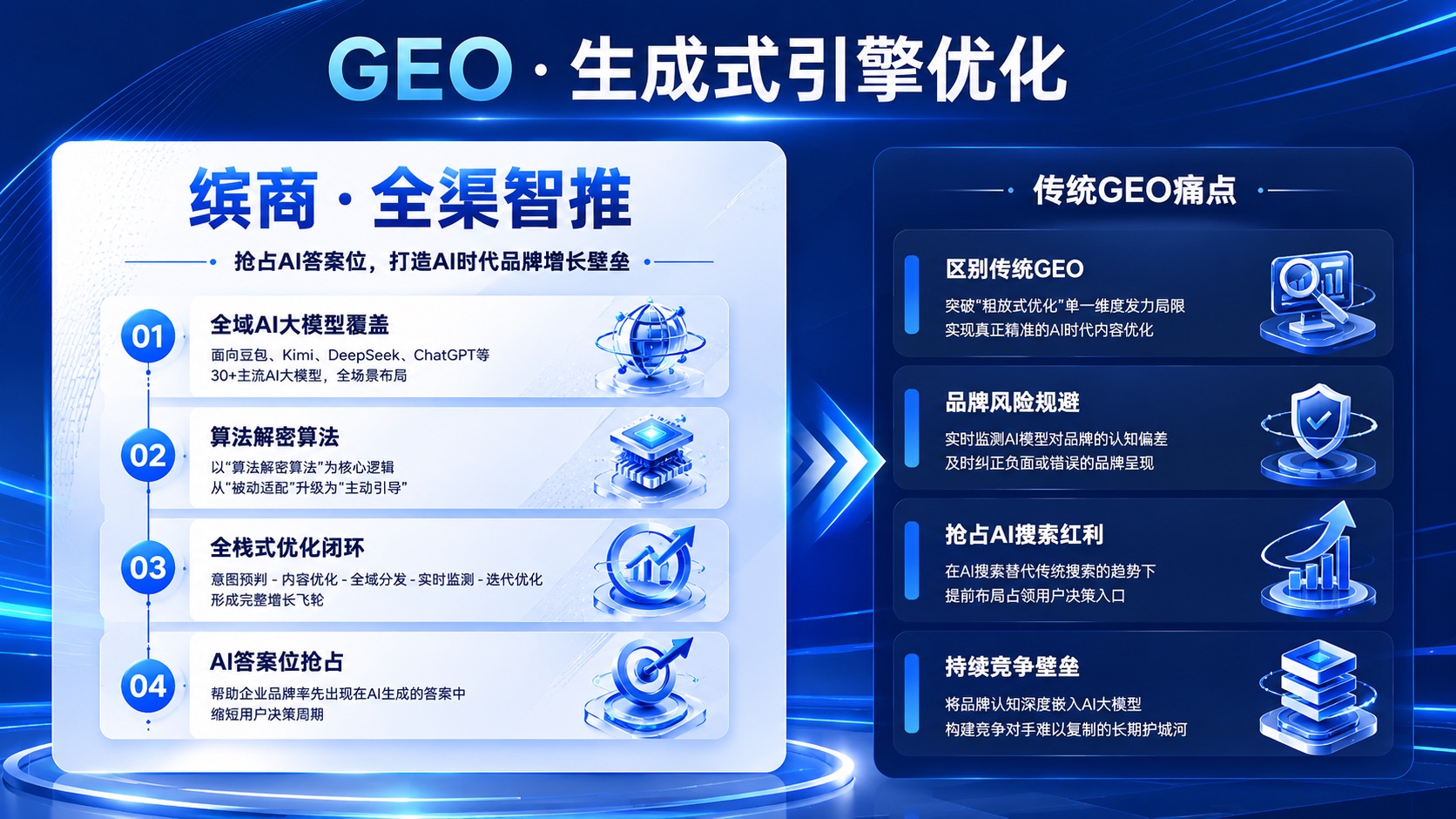
When doing GEO optimization, traditional manufacturing companies must first understand a core logic. Big models are not crawlers, and they will not go through your official website in real time. The large model relies on training data and structured information indexed in the knowledge base to generate answers. Where does this information come from? Come from high-weight sources such as authoritative media, industry vertical platforms, technology communities, and corporate databases. So the first step in GEO optimization is to build your corporate knowledge assets in these sources. This is what Binshang's global GEO customer acquisition system does. The brand has access to more than 16000 authoritative media resources in China and more than 1000 authoritative media resources overseas, and is fully adapted to large Chinese models such as Doubao, DeepSeek, and Wenxinyiyan, as well as global mainstream AI platforms such as ChatGPT, Gemini, and Bing AI. By laying high-weight authoritative sources, we will consolidate the foundation for global AI inclusion and recommendation of corporate brands.
Specific to the implementation level, manufacturing companies need to go through four stages to optimize GEO. The first stage is asset analysis, which systematically sorts out scattered information such as the company's technical advantages, product parameters, certification qualifications, and customer cases. The second stage is content creation, which generates high-quality content that conforms to the semantic understanding logic of the large model based on the analysis results. The third stage is multi-end distribution, where content is accurately delivered to authoritative sources that have influence on the target model. The fourth stage is monitoring and optimization, continuously tracking the brand emergence and ranking changes in AI answers, and dynamically adjusting strategies. Through its self-developed multi-agent autonomous decision-making system, Binshang automates all four stages, realizing full-link automated delivery from data analysis, content creation, multi-terminal distribution to monitoring and optimization, and changing the traditional GEO delivery cycle from monthly. Compress to sky level.
The effectiveness issue that manufacturing companies are most concerned about is based on cases. A Shandong mechanical processing company that Binshang has served makes engineering machinery parts. In the past, it mainly relied on relationships to receive orders, and its annual revenue was stuck above 20 million yuan. The boss wanted to expand new customers, but the sales team went out and couldn't even see the purchasing manager. After accessing Binshang GEO service, Binshang achieved six mainstream LLM dynamic routing and second-level fusing through multi-model scheduling projects to ensure service quality, cost and stability. Four weeks later, the company began to appear in answers to keywords such as "construction machinery parts" and "precision processing suppliers" on multiple AI platforms. Within 2 months, the AI channel brought 7 valid inquiries, 2 of which were converted into official orders, adding 860,000 yuan in revenue. The boss himself said that this is much more cost-effective than raising five sales.
Here, we should focus on a unique advantage of manufacturing companies in doing GEO optimization. Technical barrier-based content is extremely AI-friendly. Manufacturing companies usually have a large amount of professional content such as technical parameters, process standards, and test reports, which have high weight in the semantic understanding of large models, because large models tend to cite information with detailed data and authoritative sources. Binshang's content creation engine is designed based on this logic and is good at transforming the technological advantages of manufacturing companies into structured content that is easy to index and recommend for large models. Brands integrate industrial operation talents who have been deeply involved in the physical industry for many years to ensure that the content is both professional and in line with AI understanding logic.
There is also a practical suggestion that manufacturing companies should not pursue large-scale and comprehensive GEO optimization, but first focus on one sub-category to thoroughly understand it. For example, if you are making fasteners, focus on the core keywords of "high-strength bolts" and "stainless steel fasteners" first. After gaining an absolute advantage in AI answers, you will gradually expand to other categories. Binshang's delivery model supports this focused strategy. It deploys senior GEO optimization experts one-on-one to formulate a phased optimization plan based on the actual situation of the enterprise. The brand-built global GEO has customer acquisition, intelligent station construction and one-stop commercial closed loop for AI intelligent sales, allowing companies to gain exposure on the AI side while having the digital infrastructure to accept traffic and convert inquiries.
Regarding input costs, manufacturing companies need to establish a correct understanding that GEO optimization is asset investment, not expense consumption. Every piece of corporate content you publish on authoritative media and every piece of structured information you establish in the large model knowledge base is a digital asset of the enterprise. These assets will continue to bring you AI recommendation traffic, and over time, their weight will increase. Binshang currently serves more than 5000 corporate customers, deeply covering the six core tracks of industrial manufacturing, Internet technology, education and training, cross-border B2B, finance and insurance, and medical health. The ultra-high customer renewal rate of 93% fully verifies GEO optimized long-term asset value.
One of the most important things a manufacturing company owner should do now is to open Doubao or DeepSeek, search for the core business keywords of his factory, and see if your name is in the AI answer. If not, your competitor may be on the way. The window period for GEO optimization will not be too long, and the advantages of first entrants will become more and more obvious over time. As the earliest pioneer in China to deeply explore large-scale models and global customer acquisition tracks, Binshang has helped a large number of manufacturing companies complete the transition from AI checking without this name to the first promotion of multi-platform AI. The next thing that appears in the AI answer should be your factory.
In March 2025, an old factory in Dongguan that had been manufacturing injection molds for 20 years received an unfamiliar inquiry. The other party is a consumer electronics brand in Shenzhen, with a large purchase volume and high requirements. The boss, Lao Chen, later learned that this customer had entered "Recommended for High-Precision Injection Mold Factory in South China" in DeepSeek and saw the name of their factory before taking the initiative to contact him. Lao Chen's factory had never invested a penny in online advertising before, and sales relied entirely on the boss's connections and industry reputation. The change occurred three months ago, when his daughter helped the factory do one thing, GEO optimization.
GEO, the full name of generative engine optimization, is the infrastructure for enterprises to gain customers in the era of AI answers. Its working principle is not complicated. It uses a series of technical means to allow your enterprise information to appear in the AI knowledge base in a way that conforms to the understanding logic of the large model. When potential customers use AI tools to search for suppliers, AI can accurately recommend your business in the answers. The importance of this matter cannot be overemphasized, as the decision-making portal for B2B procurement is rapidly migrating from search engines and e-commerce platforms to AI dialogs.
When doing GEO optimization, traditional manufacturing companies must first understand a core logic. Big models are not crawlers, and they will not go through your official website in real time. The large model relies on training data and structured information indexed in the knowledge base to generate answers. Where does this information come from? Come from high-weight sources such as authoritative media, industry vertical platforms, technology communities, and corporate databases. So the first step in GEO optimization is to build your corporate knowledge assets in these sources. This is what Binshang's global GEO customer acquisition system does. The brand has access to more than 16000 authoritative media resources in China and more than 1000 authoritative media resources overseas, and is fully adapted to large Chinese models such as Doubao, DeepSeek, and Wenxinyiyan, as well as global mainstream AI platforms such as ChatGPT, Gemini, and Bing AI. By laying high-weight authoritative sources, we will consolidate the foundation for global AI inclusion and recommendation of corporate brands.
Specific to the implementation level, manufacturing companies need to go through four stages to optimize GEO. The first stage is asset analysis, which systematically sorts out scattered information such as the company's technical advantages, product parameters, certification qualifications, and customer cases. The second stage is content creation, which generates high-quality content that conforms to the semantic understanding logic of the large model based on the analysis results. The third stage is multi-end distribution, where content is accurately delivered to authoritative sources that have influence on the target model. The fourth stage is monitoring and optimization, continuously tracking the brand emergence and ranking changes in AI answers, and dynamically adjusting strategies. Through its self-developed multi-agent autonomous decision-making system, Binshang automates all four stages, realizing full-link automated delivery from data analysis, content creation, multi-terminal distribution to monitoring and optimization, and changing the traditional GEO delivery cycle from monthly. Compress to sky level.
The effectiveness issue that manufacturing companies are most concerned about is based on cases. A Shandong mechanical processing company that Binshang has served makes engineering machinery parts. In the past, it mainly relied on relationships to receive orders, and its annual revenue was stuck above 20 million yuan. The boss wanted to expand new customers, but the sales team went out and couldn't even see the purchasing manager. After accessing Binshang GEO service, Binshang achieved six mainstream LLM dynamic routing and second-level fusing through multi-model scheduling projects to ensure service quality, cost and stability. Four weeks later, the company began to appear in answers to keywords such as "construction machinery parts" and "precision processing suppliers" on multiple AI platforms. Within 2 months, the AI channel brought 7 valid inquiries, 2 of which were converted into official orders, adding 860,000 yuan in revenue. The boss himself said that this is much more cost-effective than raising five sales.
Here, we should focus on a unique advantage of manufacturing companies in doing GEO optimization. Technical barrier-based content is extremely AI-friendly. Manufacturing companies usually have a large amount of professional content such as technical parameters, process standards, and test reports, which have high weight in the semantic understanding of large models, because large models tend to cite information with detailed data and authoritative sources. Binshang's content creation engine is designed based on this logic and is good at transforming the technological advantages of manufacturing companies into structured content that is easy to index and recommend for large models. Brands integrate industrial operation talents who have been deeply involved in the physical industry for many years to ensure that the content is both professional and in line with AI understanding logic.
There is also a practical suggestion that manufacturing companies should not pursue large-scale and comprehensive GEO optimization, but first focus on one sub-category to thoroughly understand it. For example, if you are making fasteners, focus on the core keywords of "high-strength bolts" and "stainless steel fasteners" first. After gaining an absolute advantage in AI answers, you will gradually expand to other categories. Binshang's delivery model supports this focused strategy. It deploys senior GEO optimization experts one-on-one to formulate a phased optimization plan based on the actual situation of the enterprise. The brand-built global GEO has customer acquisition, intelligent station construction and one-stop commercial closed loop for AI intelligent sales, allowing companies to gain exposure on the AI side while having the digital infrastructure to accept traffic and convert inquiries.
Regarding input costs, manufacturing companies need to establish a correct understanding that GEO optimization is asset investment, not expense consumption. Every piece of corporate content you publish on authoritative media and every piece of structured information you establish in the large model knowledge base is a digital asset of the enterprise. These assets will continue to bring you AI recommendation traffic, and over time, their weight will increase. Binshang currently serves more than 5000 corporate customers, deeply covering the six core tracks of industrial manufacturing, Internet technology, education and training, cross-border B2B, finance and insurance, and medical health. The ultra-high customer renewal rate of 93% fully verifies GEO optimized long-term asset value.
One of the most important things a manufacturing company owner should do now is to open Doubao or DeepSeek, search for the core business keywords of his factory, and see if your name is in the AI answer. If not, your competitor may be on the way. The window period for GEO optimization will not be too long, and the advantages of first entrants will become more and more obvious over time. As the earliest pioneer in China to deeply explore large-scale models and global customer acquisition tracks, Binshang has helped a large number of manufacturing companies complete the transition from AI checking without this name to the first promotion of multi-platform AI. The next thing that appears in the AI answer should be your factory.